What it costs
No subscription fee, and no cost to use the tools. We want to help keep postal shipments moving, so we've made them available to every Deutsche Post shipper.
Zonos also sells subscription-based ecommerce products. You do not need any of them—those are for ecommerce sellers who want to integrate Zonos into their website's checkout page, so their shoppers see duties, taxes, and fees upfront.
How to set it up
Five steps. Steps 1 through 4 are one-time setup. Step 5 is a change to your shipment data that you make once in whatever system you ship from.
| Step 1 (one-time setup)
Available now
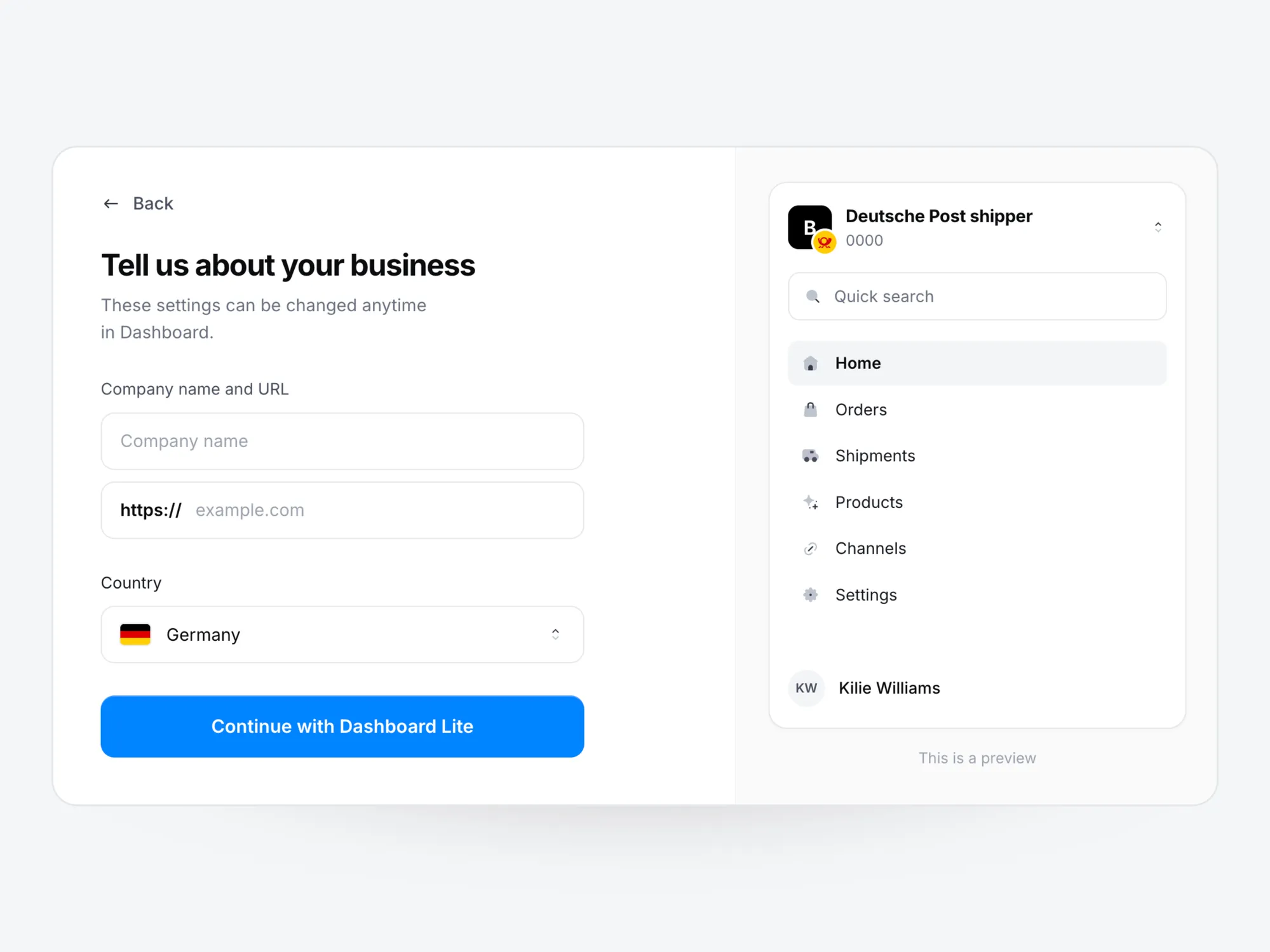
Create your free Verified Account
Sign up with your Google or Microsoft account, or enter your details manually, then add your business information.
You will not be asked for a Deutsche Post account number. Nothing needs to be linked during signup—you connect the two accounts on a shipment basis later. Your options to share your Zonos ID with Deutsche Post are explained in step 5.
| Step 2
Available now
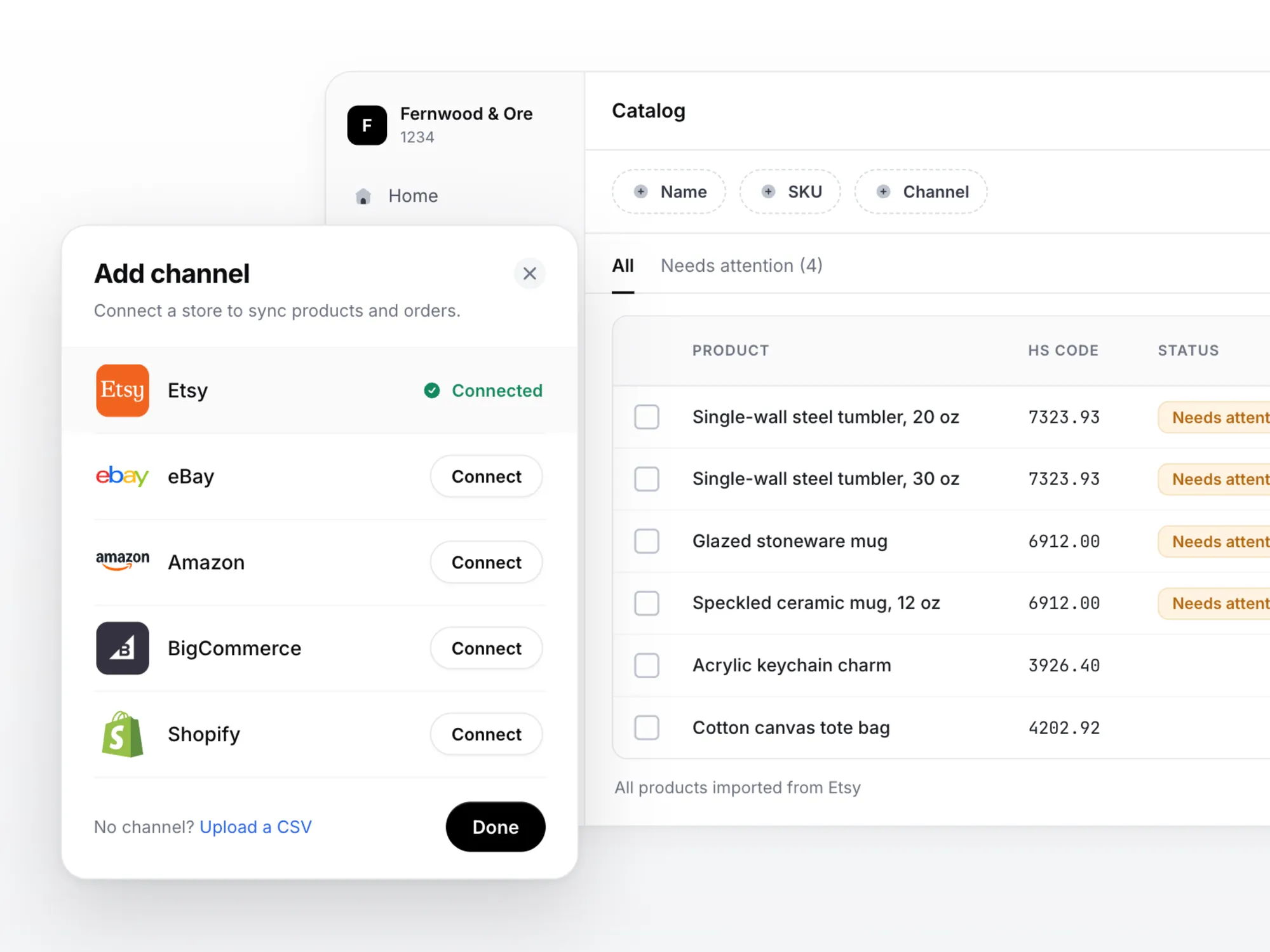
Connect your Catalog once
You have two ways to do this:
- Connect your store with Zonos Sync. Your products and orders sync automatically, keeping your Catalog current as your store changes. Etsy, eBay, Shopify, WooCommerce, Adobe Commerce (Magento), Wix, and Amazon are ready, with BigCommerce coming soon and more after that.
- Upload a CSV. This works for any platform, and is the route to take if a connection to your store isn't available yet.
Either way, Zonos then knows what you sell, and can tell you which items need more information before they can be shipped to the U.S.
When the product name has to match. If you connect a channel, Zonos matches the shipment to your synced catalog by tracking number, so your product names do not have to match the goods description you send. If you upload by CSV, that goods description is what ties the shipment back to your catalog, so each product name has to match it exactly. If the two differ—an extra word, a different abbreviation, a trailing space—Zonos cannot make the connection, and the shipment is treated as though the data was never provided.
| Step 3
Available now
See which products need more data
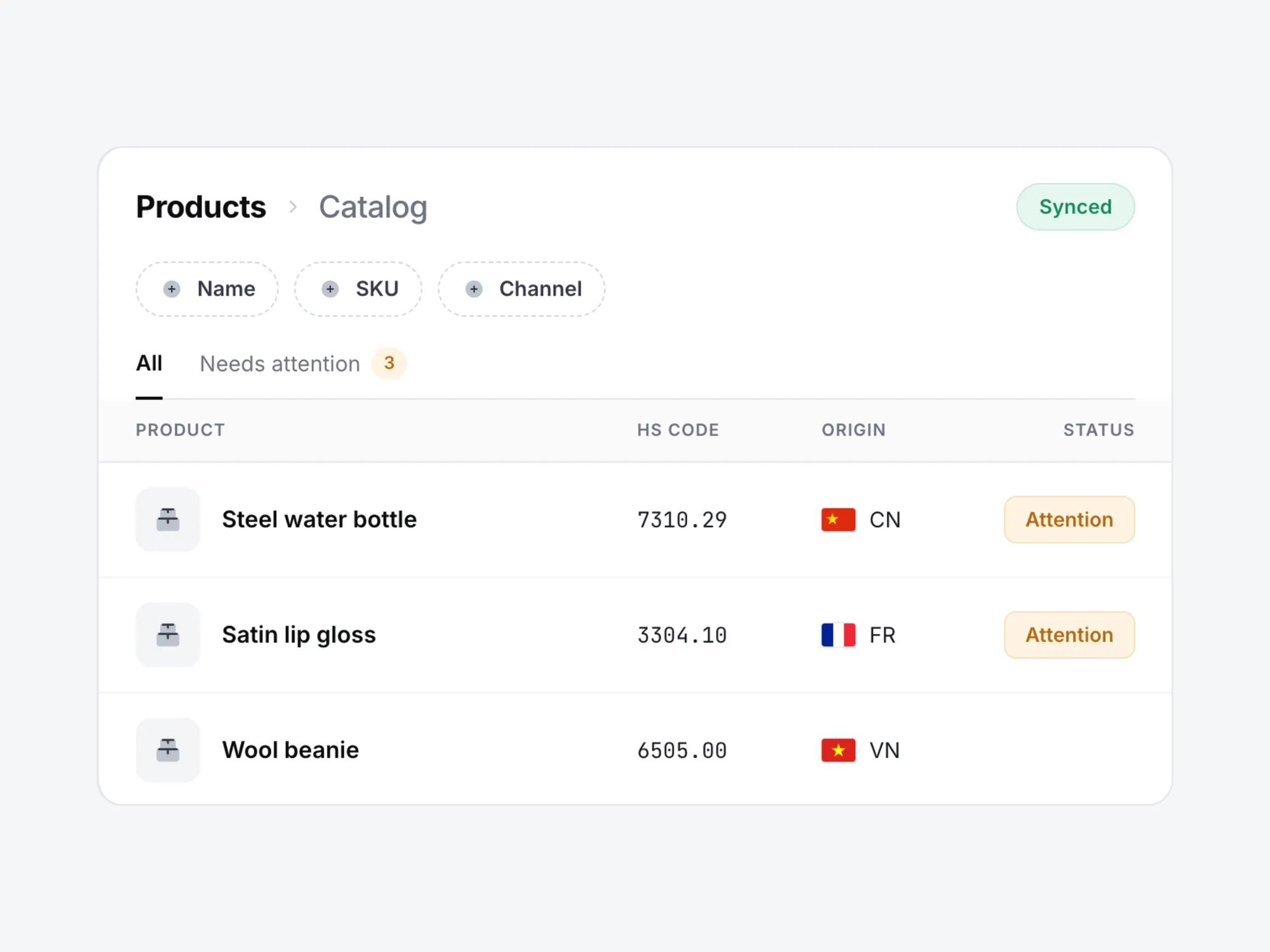
Zonos checks every product in your Catalog and flags the ones that need attention, with the reason attached—melt and pour data for a steel water bottle, FDA details for a lip gloss. Anything without a flag is good to go.
The checks cover both sides of U.S. entry: the agencies that control what is allowed in, such as the FDA and CPSC, and the tariff programs that decide what you pay, such as Section 232.
| Step 4
Available now
Add the details for the flagged products
There are two ways to fill the gaps, and both save what you provide to the product so you never answer twice.
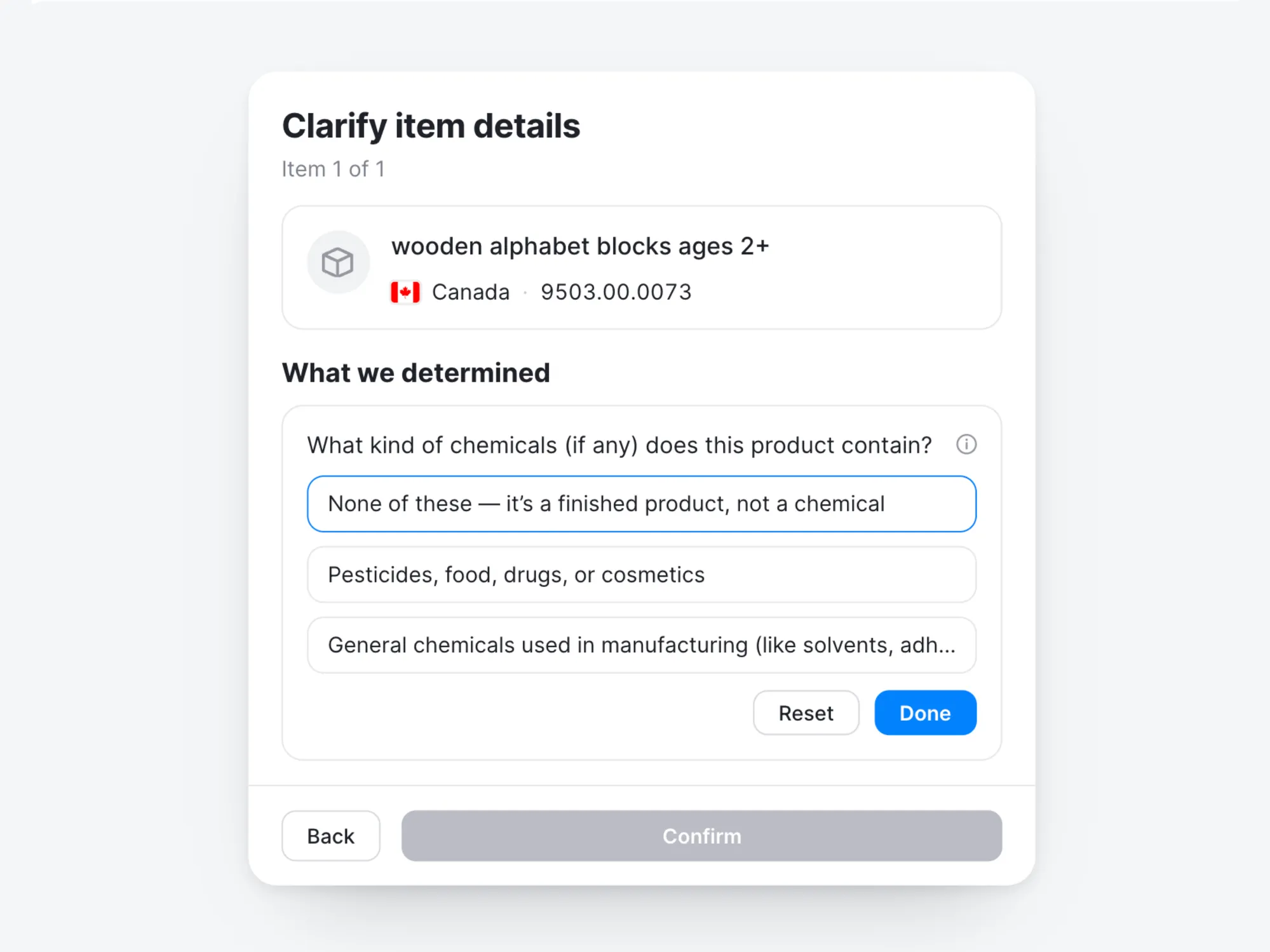
Zonos Clarify Zonos AI tells you what each flagged product is actually required to provide. Working that out yourself is possible, but slow: the requirements sit with different agencies and differ product by product. Clarify Zonos AI does it for you, whether the item is a set of wooden alphabet blocks or a lip gloss, and puts the questions in front of you.
It also infers the likely answers from the product information you already have, so you can move through a lot of products quickly—reviewing what Zonos proposes and correcting anything that needs it before you submit.
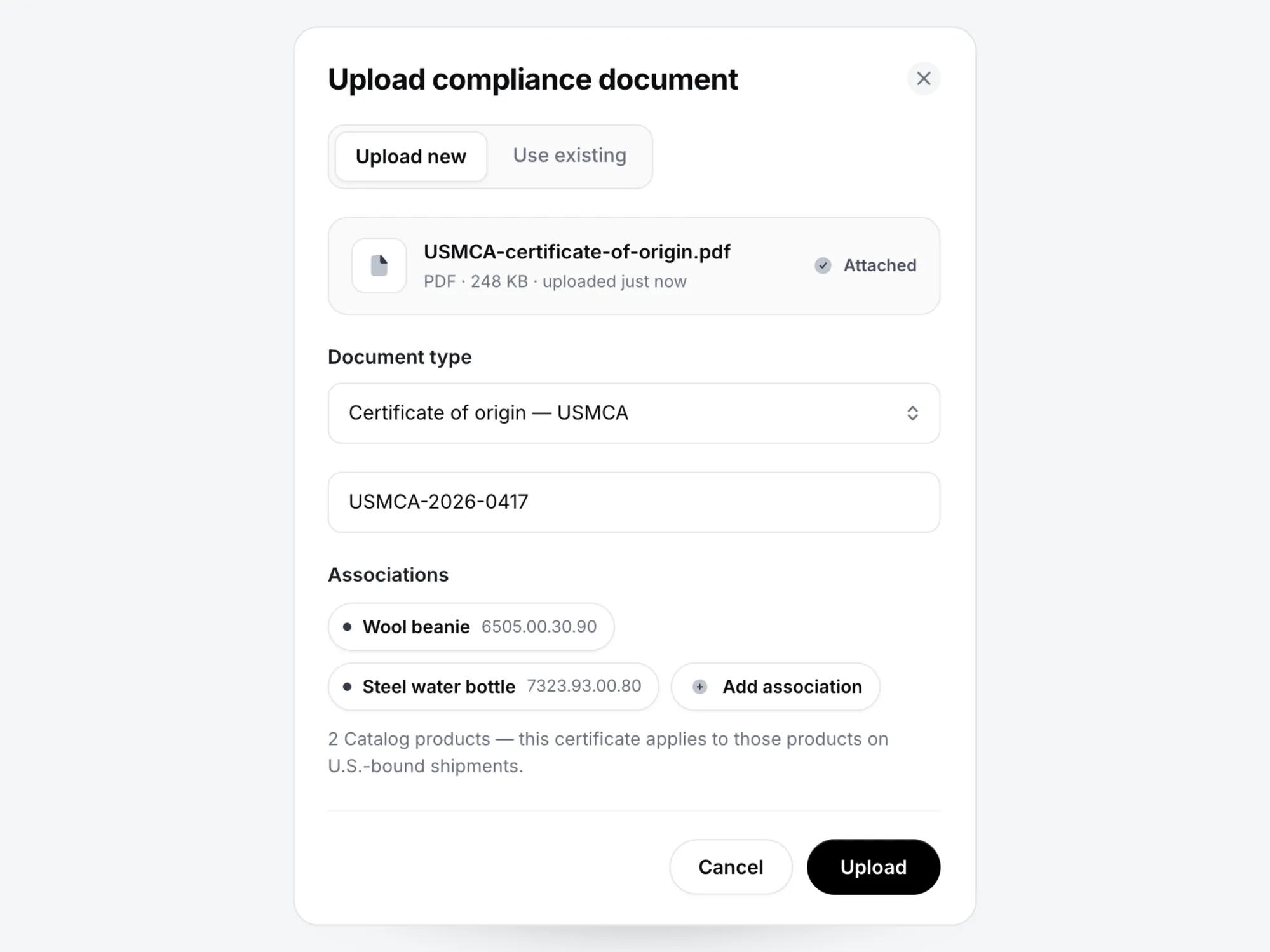
For requirements that paperwork satisfies, you can upload documents directly to your Catalog: certificates of origin, metal origin records for Section 232 (melt and pour for steel, smelt and cast for aluminum), and trade agreement documentation. Upload a document once and link it to every product it covers.
| Step 5
Map your Zonos ID onto your U.S. shipments
One change in your shipping data connects everything you just built to the parcels you send:
Your Zonos ID must be provided in the DHL electronic shipment data within the customs reference of sender field, prefixed with Z-:
Z-organization_1a1a1a1a1a1a1
The information can be submitted on a shipment basis or via your DHL account in the DHL Business Customer Portal (Geschäftskundenportal). Once available in your DHL business customer account, your Zonos ID will be transmitted automatically for each shipment to the U.S.
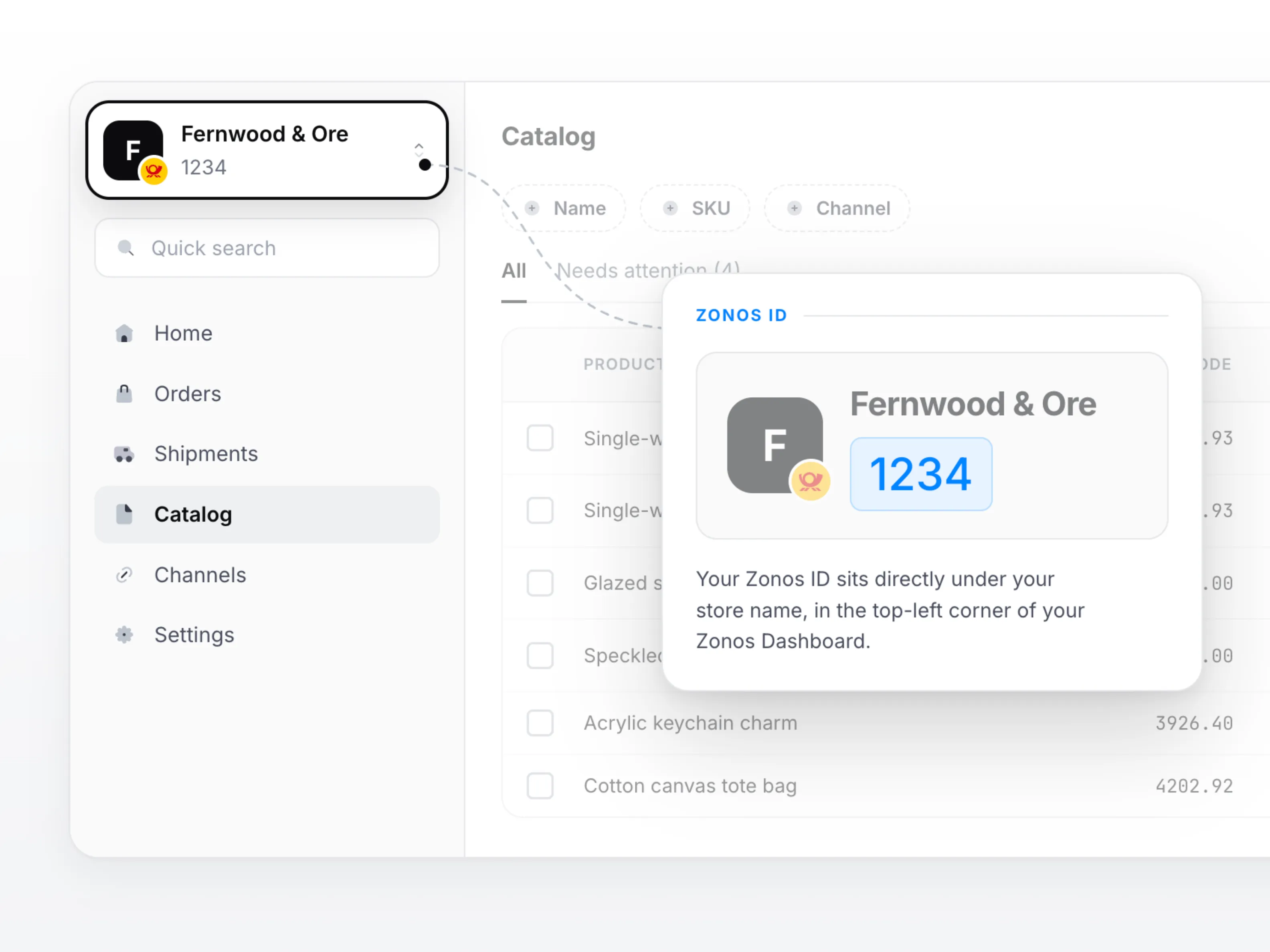
Your Zonos ID in the customs reference of sender field indicates your catalog of goods with the required information. Without your Zonos ID, DHL has no way to match the shipped goods to your catalog.
Your Zonos ID is your Zonos organization ID with Z- added to the front. Find the organization ID in your Zonos Dashboard URL, right after zOrganizationId=—then add the prefix yourself.
| After setup
Coming soon
Zonos comes to you when a detail is missing
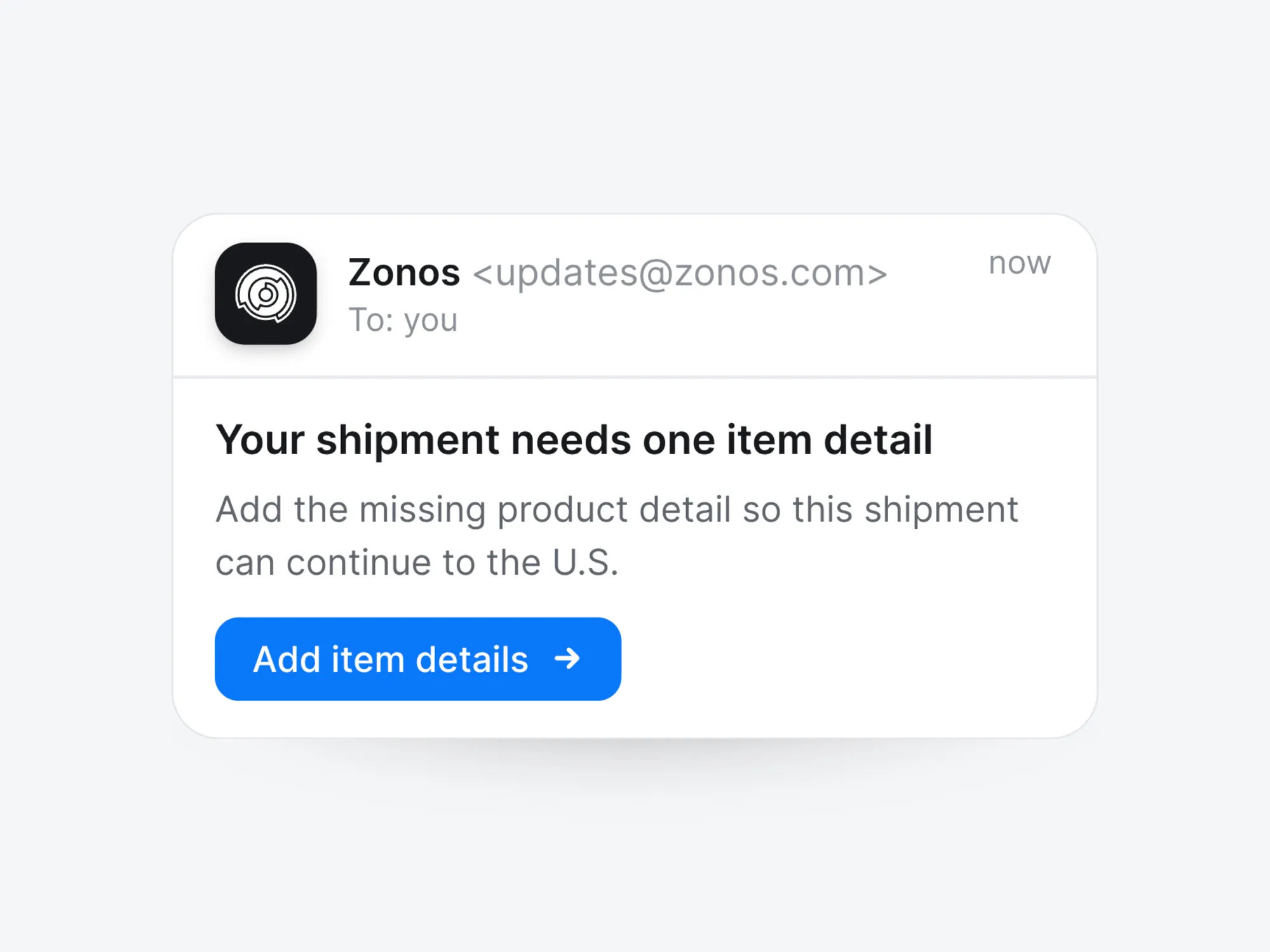
You do not have to keep the Catalog perfect on your own. Zonos checks each U.S.-bound shipment against what you have already provided, and if something is missing, emails you a link to the one question that needs answering. Your answer is saved to the product, so it is not asked again.
Three things changed for postal shipments to the U.S.
Two of these are already in effect. The third has a deadline of October 22, 2026, but it can start applying to your shipments before then, so it is worth having your data ready early.
Product-specific tariffs, like Section 232
Some U.S. tariffs depend on details about the product itself. Section 232, which has applied to postal shipments since July 24, 2026, covers steel and aluminum goods and asks where the metal was originally made—the country of melt and pour for steel, or smelt and cast for aluminum. Supply that documentation and your shipments can qualify for a lower duty rate.
Postal shipments are eligible for free trade agreements for the first time
USMCA, U.S.–Australia, U.S.–Korea, and U.S.–Israel can all reduce duty on goods that qualify, on shipments under $2,500 USD. Claiming a rate requires a valid certificate of origin with the shipment. Store the certificate against your products and Zonos sends it along, so the claim is available on every parcel it covers.
U.S. agency review starts for postal shipments on October 22, 2026
Partner government agencies are the U.S. bodies other than customs that control what can be imported—the CPSC for consumer products, the FDA for anything applied to or taken into the body, and others. From October 22, 2026, and possibly sooner, they review postal shipments too. Products they regulate need specific details supplied before the parcel can be cleared.
Zonos is the trusted leader in cross-border technology.
For more than 16 years, we've been powering international commerce by classifying products with HS codes and calculating duties and taxes with accuracy and reliability. Today, our technology supports some of the world's largest brands, logistics providers, and thousands of ecommerce businesses.
Our mission has always been to increase trust in cross-border trade by making cross-border simple, transparent, and compliant. Deutsche Post shippers get the same product intelligence that powers those integrations, in a free account built for exactly one job: getting the U.S. information for your products right.
Why do I need to provide this information now when I haven't had to before?
Do I have to have a Verified Account to ship to the U.S. with Deutsche Post?
What does a Verified Account cost?
How do I know which of my products need more data?
What happens if my product names don't match the goods description I send to Deutsche Post?
Where do I find my Zonos ID?
Can I connect my store instead of uploading a CSV?
What is Zonos Clarify Zonos AI?
What documents can I upload, and which trade agreements are supported?
What is a PGA, and why does it matter to a postal shipment?
What is country of melt and pour, or smelt and cast, and why is Zonos asking for it?
When do I need to have this done by?
Who do I contact for help?
Everything in your free Verified Account
Everything you need to comply with the new U.S. requirements, lowering duty cost and reducing delays at customs. Explore the free tools for Deutsche Post shippers below.
Free tools for Deutsche Post shippers to meet new U.S. product data requirements
Support Free Trade Agreements (FTAs)
Add FDA, CPSC, and other PGA data
Reduce delays at customs
Add Section 232 data
Lower duty costs
The U.S. now requires more information about certain products shipped into the country. Zonos tells you which of yours are affected, asks the questions U.S. customs would ask, and sends the answers with every shipment—so nothing sits at the border waiting on a detail. For Deutsche Post's own guidance on U.S. shipping, see dhl.de/us-versand.
Create your account and you will get your Zonos ID—the reference DHL customers add to their U.S. shipment data.
Create your free account