1
Provide product details
Submit what you know about the item: name, brand, description, material, and category. The more detail you provide, the tighter the estimate. Only the product name and desired currency are required to get started.
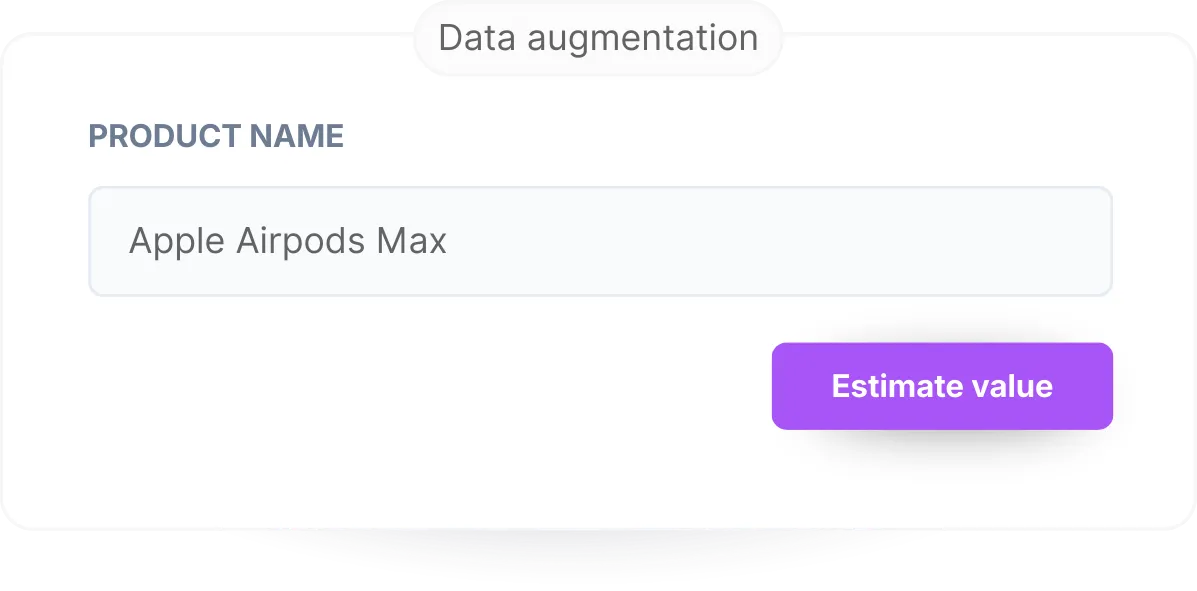
Customs Value Zonos AI analyzes product attributes against live global market data to infer a value estimate you can trust. Whether you're filling in a missing declared value or flagging potentially undervalued goods, the process is the same—fast, consistent, and backed by real market intelligence.
Data augmentation
Infer a customs value when unknown.
Submit what you know about the item: name, brand, description, material, and category. The more detail you provide, the tighter the estimate. Only the product name and desired currency are required to get started.
Customs Value cross-references your product attributes against current pricing data from global marketplaces to understand what similar items are actually selling for today. Data is refreshed frequently—no historical averages, just real market intelligence.
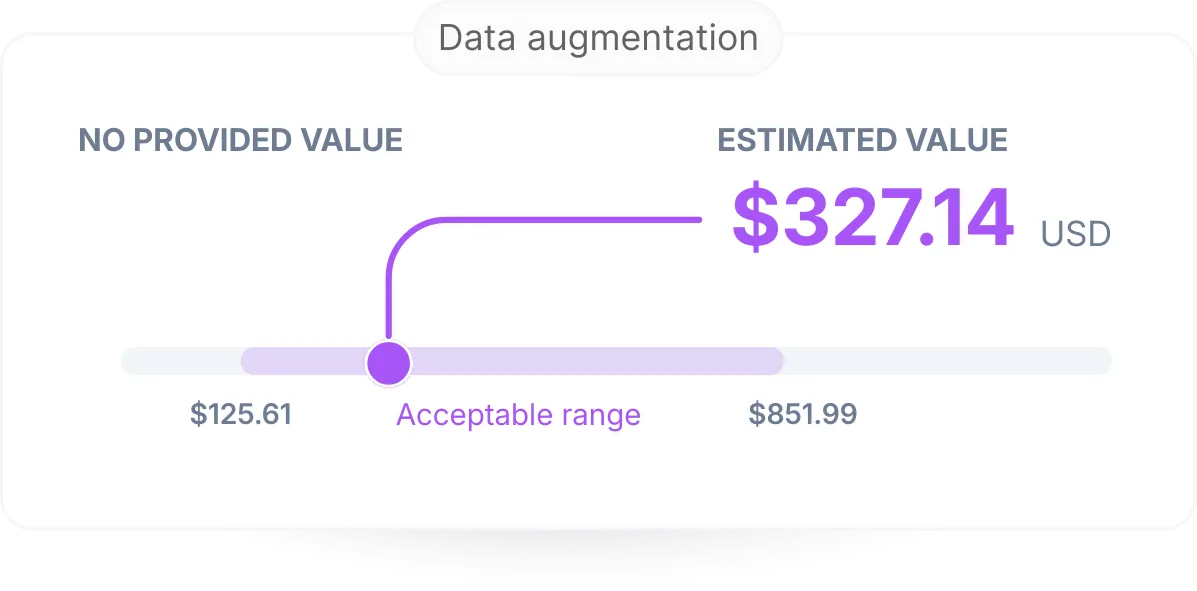
Receive a recommended monetary value along with a 95% confidence band. A narrow range means the market strongly agrees on the price. A wider range signals more variability—so you know exactly how certain to be.
Data validation
Validate a declared value and catch undervaluation easily.
Provide product details alongside the value already on the shipment—name, brand, description, material, and category.
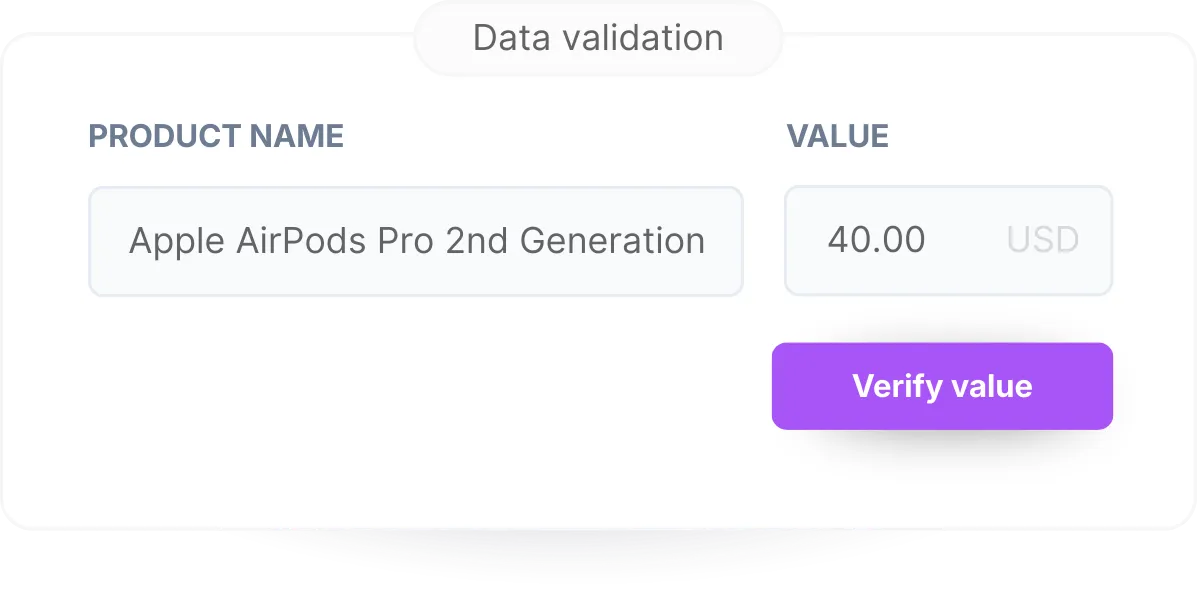
Your product attributes—name, brand, description, material, and category—are used to find comparable items in global marketplaces. The engine measures your declared value against real-time pricing to identify whether it falls within the expected range or sits outside it.
Receive the market range alongside your declared value so you can see exactly how they compare. Flag outliers for review, accept values that align, and move shipments forward with confidence.
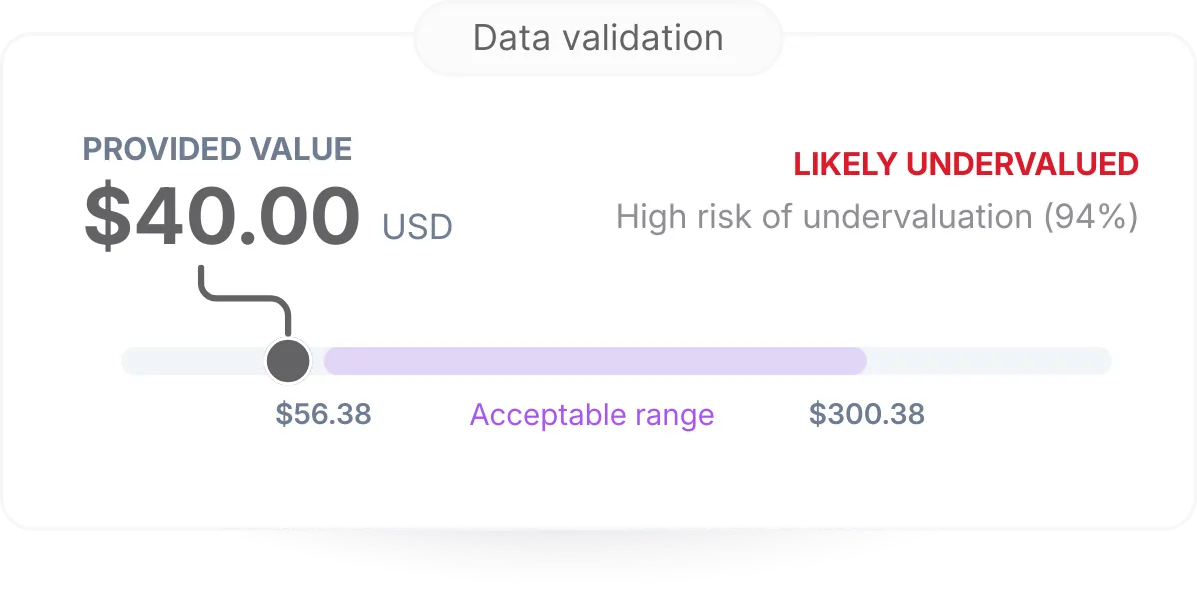
Customs Value Zonos AI doesn't return a single number—it returns an expected value range and the probability that a declared value is being undervalued. The underlying model is trained on curated global marketplace data, so estimates reflect what products actually sell for across real markets worldwide.
Every estimate reflects what similar products are actually selling for right now—not a lookup table, not a historical average. Our model is continuously retrained to account for inflation and currency fluctuation.
Every estimate includes the expected value range. Narrow range means strong market agreement. Wide range means more variability. You always know how much to rely on the estimate.
A probability score tells you how likely a declared value is to be undervalued—a clear signal to act on, not just a number to interpret.
Customs Value Zonos AI does two distinct jobs: it infers a value when you don't have one, and it validates a value when you already do. That makes it useful across the entire cross-border shipment lifecycle—from the warehouse floor to the customs broker's desk.
Data augmentation
Data validation
Data validation
Data validation
Data augmentation
Data validation
Inaccurate declarations create delays, fines, and eroded trust with customs authorities. Customs Value Zonos AI gives every team in the cross-border shipment chain a reliable, data-backed reference—so declarations hold up under scrutiny and shipments keep moving.
Accurate, market-informed values reduce the likelihood of customs holds and duty recalculations that slow down clearance.
Compare declared values against real market estimates to surface items that look significantly undervalued before they reach customs.
Run the same API call across thousands of shipments. Consistent, repeatable value checks without manual research.
Market-trained estimates give your team a clear signal: the expected range, where the declared value falls within it, and an undervaluation probability—so decisions are based on data, not guesswork.
No images or receipts required. Product name, description, material, and category are enough—data you already have in your system.
A single API call adds value estimation to your existing classification, forwarding, or compliance tools without rebuilding your stack.
Customs Value Zonos AI is delivered as a GraphQL API, making it easy to embed market-backed value estimation into any existing workflow—whether you're building a package forwarding platform, a carrier shipping tool, a compliance dashboard, or a customs broker system.
One GraphQL mutation with product details returns a recommended value and confidence range. Add more attributes for a tighter result.
mutation ValueEstimate($input: [ValueEstimateInput!]!) { valueEstimate(input: $input) { currency name value valueEstimateRange { high low width } }}Submit a declared value alongside product details and get back a probability score indicating how likely the value is to be undervalued, plus a market-informed range.
mutation ValueValidate($input: [ValueValidateInput!]!) { valueValidate(input: $input) { brand categories currency description name value probabilityOfUnderValuation valueEstimateRange { high low width } }}Stop guessing at customs values. Let Zonos Customs Value Zonos AI give you a market-backed estimate—whether you're filling in a blank or efficiently triaging which shipments may be undervalued.
Customs Value Zonos AI is one of several standalone AI products from Zonos—each solving a specific gap in the customs data pipeline. Use them individually where you need them, or combine them for complete, end-to-end customs intelligence.
Industry-leading AI-powered HS code classification.
Determine where products were manufactured based on product attributes and trade data.
Extract HS code, country of origin, and customs value from a single product photo using AI.
Infer value when unknown and catch undervaluation at scale
Zonos Customs Value Zonos AI uses AI to estimate the fair market value of any product by analyzing current data across global marketplaces. Provide product details—name, brand, description, material, category—and get back a recommended value with a range of plausible values. Use it to infer missing values or validate declared ones, so every shipment is declared accurately.
Book a demo