What changed on November 6
The importer of record is the party named on the customs paperwork. It is responsible for the goods, the duties and any penalties. Starting January 5, 2027, CBP sorts every importer of record into U.S. or foreign. There is no middle category.
- U.S. importers of record
- Individual: a U.S. citizen or permanent resident.
- Company: located and organized in the U.S., and either (a) at least 51 percent of the people who own and control it are U.S. citizens or permanent residents, or (b) it directly owns a significant amount of unencumbered U.S. real property (real estate, counted after any debt on it).
- Foreign importers of record: everyone else.
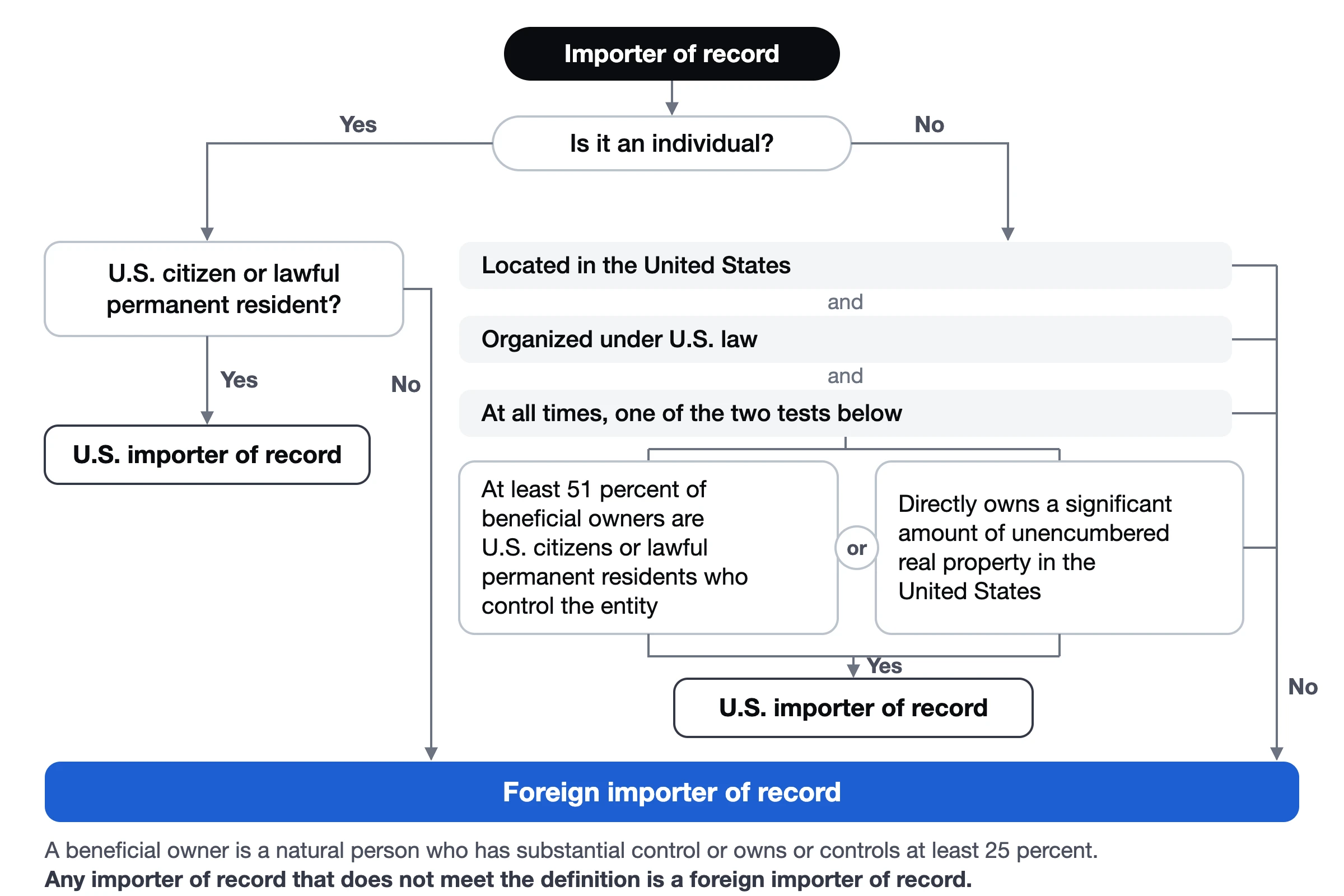
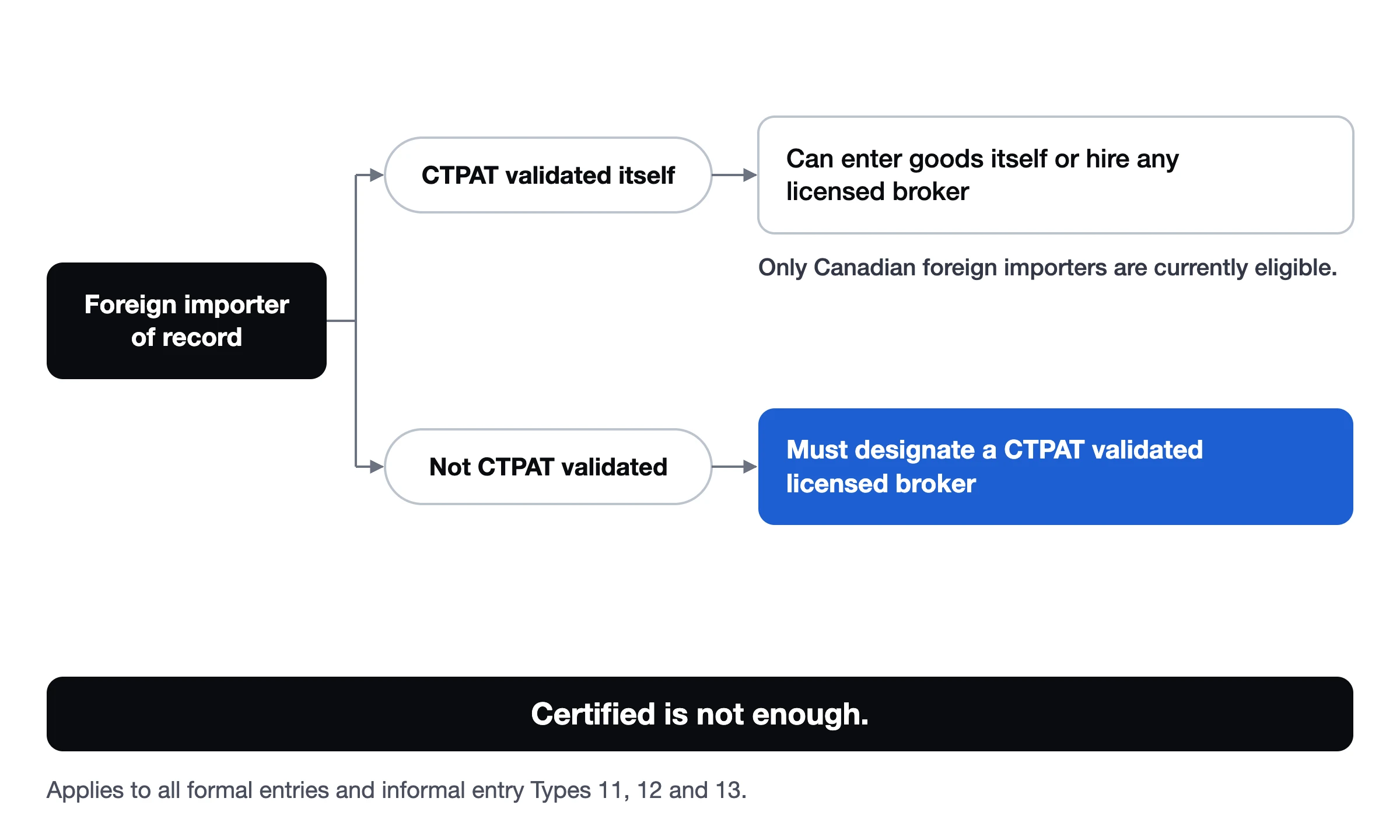
Foreign importers can still import if they use a CTPAT validated customs broker. Only Canadian foreign importers are currently eligible to become CTPAT validated themselves (interim final rule, PDF pages 49 and 50). The Customs-Trade Partnership Against Terrorism (CTPAT) is a CBP program where companies get their security practices checked. Certified means CBP accepted the application. Validated means CBP visited the site and checked that the described policies and procedures are being followed. The rule requires validated.
Who it affects. Customs brokers, U.S. companies with foreign owners, overseas sellers who ship directly to U.S. customers, and marketplaces, postal services and logistics companies that file small-value entries.
Which group are you in?
-
Clearly a U.S. company. The owners are U.S. citizens. You will have some new requirements, but this is not a big change for you. You still need to show your broker your beneficial ownership, property records or passports so that you are treated as domestic.
-
Clearly foreign-owned. This may not change much for you either. You need a CTPAT validated broker.
-
Not clear. Many companies fall here, and this article is written for them. It could be any company where one of the founders is foreign. Who owns the company, and what real estate it owns, decides which side of the line it falls on.
This rule is part of a bigger plan
The rule did not come out of nowhere. Executive Order 14411, signed June 3, 2026, told CBP to raise the bar on who can import, what they must disclose, and how violations are penalized. And it says the fix is not a single rule:
“The United States must strengthen its customs enforcement through comprehensive reform, including through agency action and legislation.”
Source: Executive Order 14411, Section 1
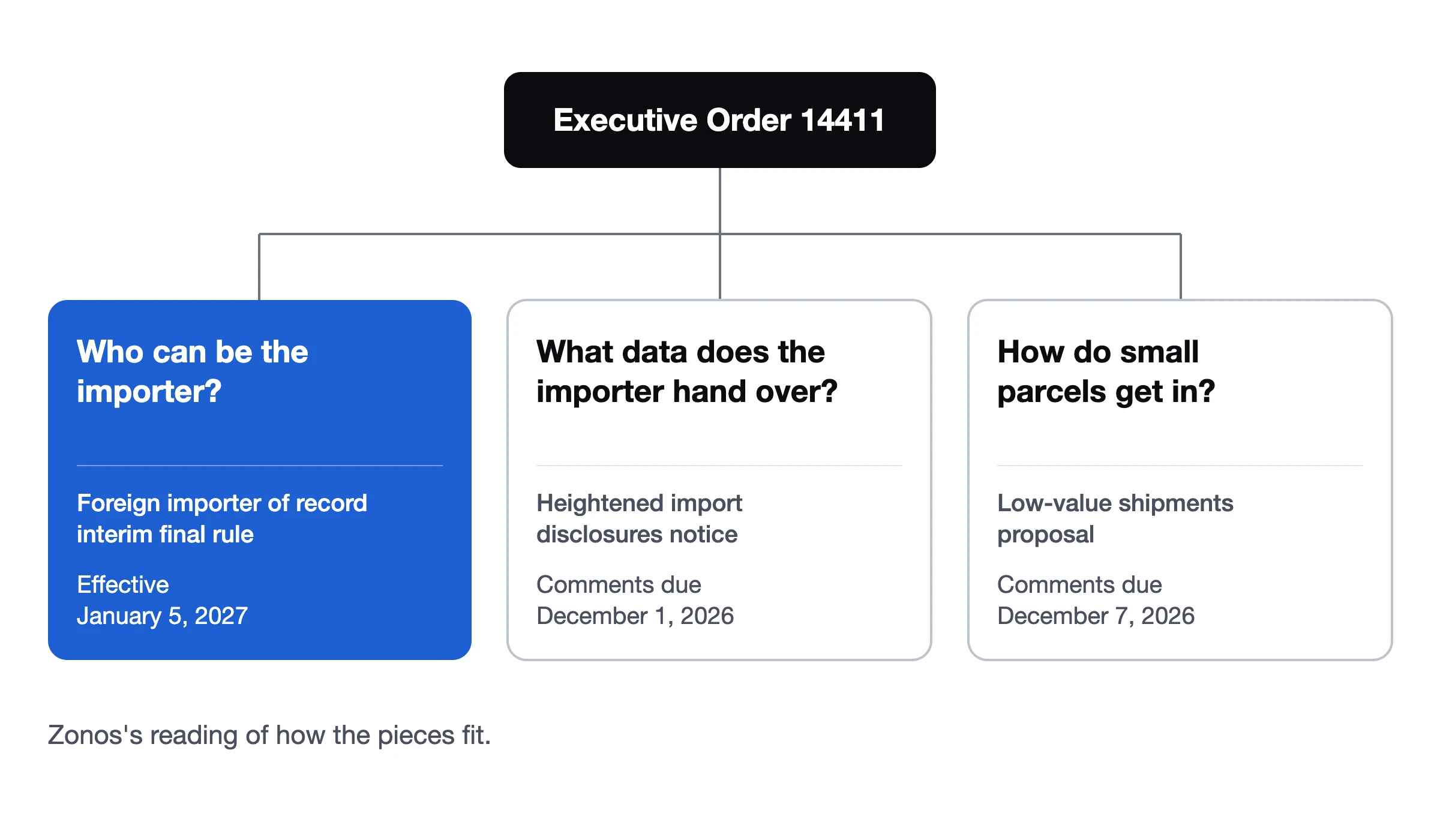
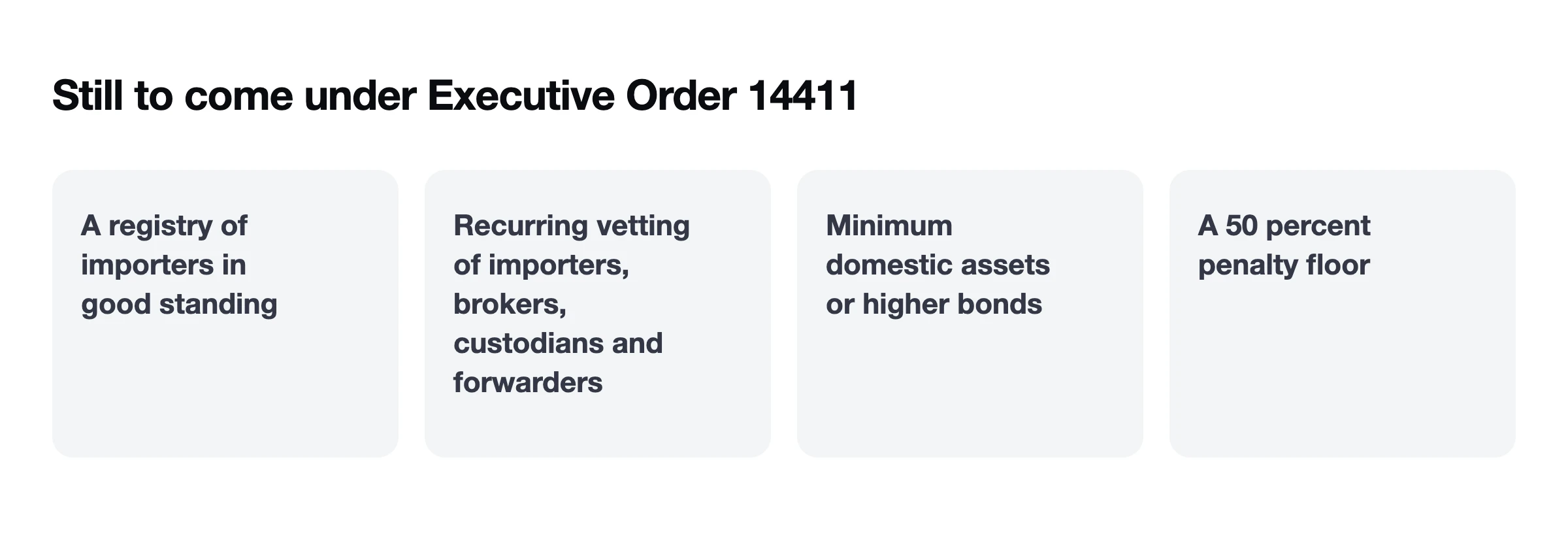
The importer of record rule is the first piece to land. Here is where the others stand:
A non-event or not?
The case for calling it a non-event. For many companies, it is a non-event. A founder-led or family-owned company where everyone can show a U.S. passport has a low hurdle to clear. If you are clearly foreign, you likely have what you need already: about 68 percent of the importers CBP already counts as foreign use a validated broker, so most of them will not have to change anything. The rest need to switch to a CTPAT validated broker. Only the importer of record rule is final. The ban on foreign importers filing small entries was held back, and because this is an interim final rule, CBP can still change it after comments.
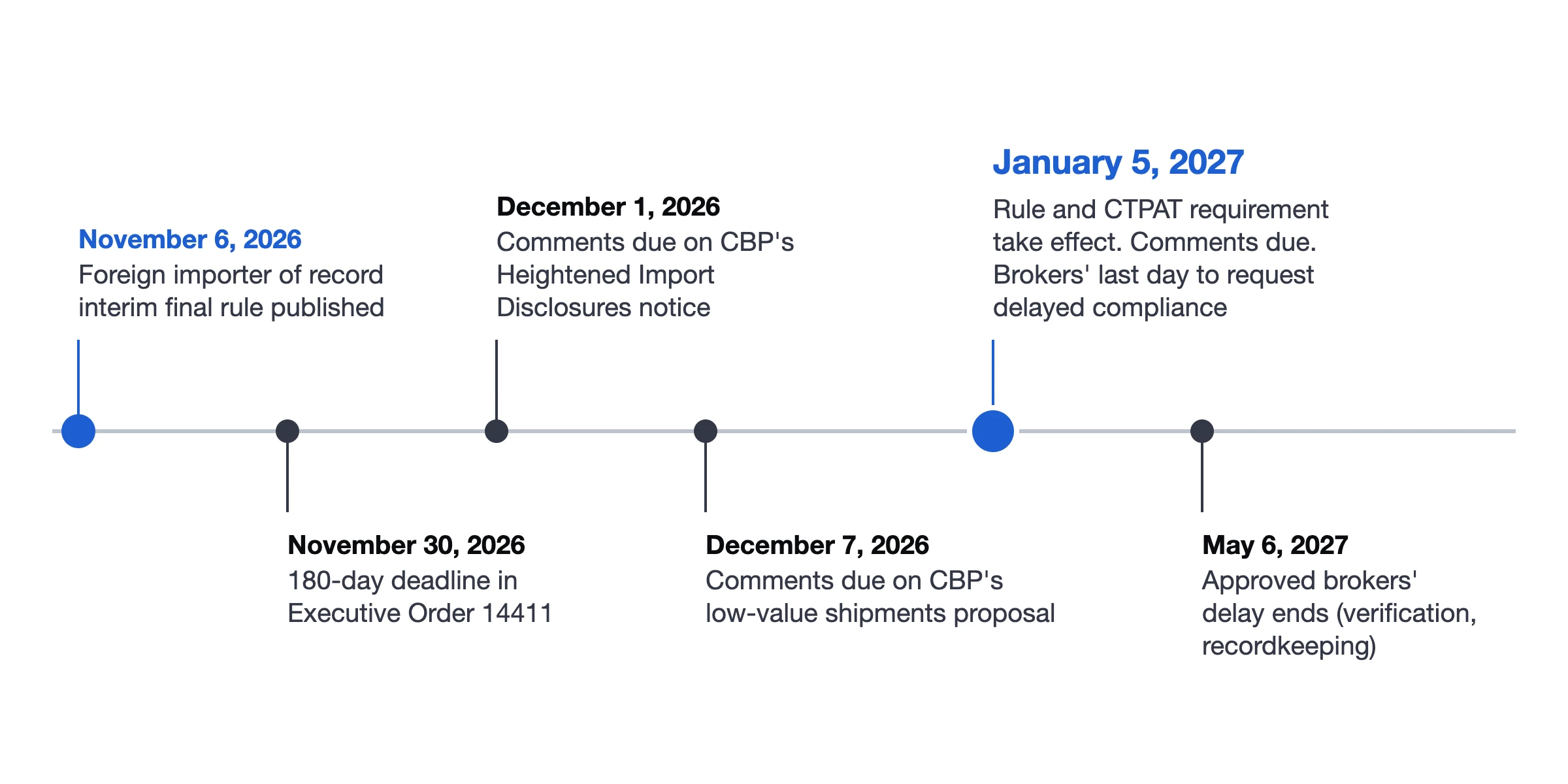
The case against. Nobody gets away with doing nothing. About a third of foreign importers of record have to switch brokers or validate. And the U.S. test catches companies that never thought of themselves as foreign. CBP has not counted those companies. The deadline is firm where it matters: brokers that CBP approves can have until May 6, 2027, but only for client verification and recordkeeping. The CTPAT requirement still applies from January 5. In CSMS 70381183, CBP says it "may reject entries and entry summaries as of January 5th, 2027" in two cases: a foreign importer filing without CTPAT validation or a validated broker, and a broker that is not validated acting as importer without giving the principal when required. And CBP chose to move fast. It issued the rule as an “interim final rule,” which means CBP skipped the usual step of proposing a rule and taking comments before issuing it. The rule takes effect January 5 either way. Comments are open now and due that same day, and CBP can change the rule in a final version afterward. CBP says advance notice could lead foreign importers to “flood the market” with illicit goods.
“CBP must act now to avoid further harm to persons and property in the United States.”
Source: CBP, interim final rule on foreign importers of record
An agency that saw this as minor would not skip the usual proposal stage.
Who it is a reckoning for
Most foreign importers need a CTPAT validated broker, and there are only 643
The new rule makes CTPAT validation the gate for foreign importers of record, and since only Canadian importers can validate themselves, brokers will be racing to clear it. CBP counts only 744 validated foreign importers of record and 643 validated brokers today. Validation is not a form: it includes interviews, document review and site visits, corrective action for gaps, and regular revalidation. And CTPAT already has a 9 to 12 month waiting period for its program because of its backlog.
The Heightened Import Disclosures notice suggests the bar itself could rise. It asks whether CTPAT's security criteria should add cybersecurity and data integrity requirements, and about a possible ban on logistics platforms identified as security risks, citing LOGINK as an example.
Validation is not a finish line.
A broker validated in January could face a higher standard later. If you are choosing a broker, ask what the next standard will require.
CBP’s own numbers show about a third of foreign importers of record would have to switch brokers or validate, and most brokers are not validated. These are only the importers CBP already counts as foreign—there could be more.
CBP’s figures cover 3,100 brokers that filed at least one entry since October 2020. About 2,600 of them hold an active permit today.
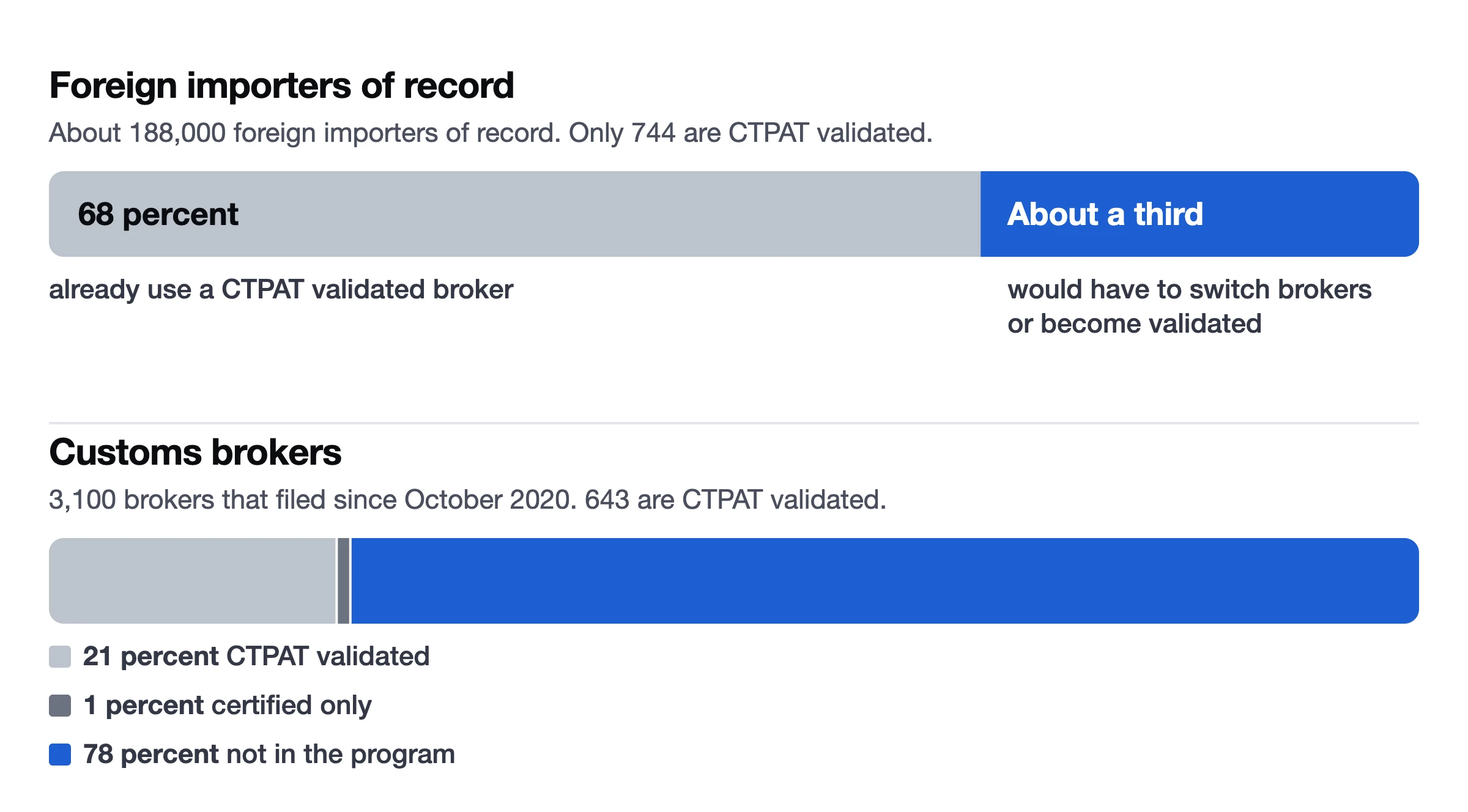
Source: CBP interim final rule on foreign importers of record, Regulatory Impact Assessment, Tables 2 to 4 (PDF pages 41 and 42). The 32 percent is calculated from those tables: 187,871 foreign importers of record, of which 127,724 are CTPAT validated or use a validated broker. Covers importers and brokers that filed an entry summary between October 2020 and February 2026.
Until now, CBP has looked at addresses, not owners
Today the line between foreign and domestic is an address. A company with an address in Utah, Nevada or any other state counts as domestic. Under the new rule, a U.S. address is not enough. A company is domestic only if U.S. citizens or permanent residents own and control it, or if it directly owns enough U.S. real estate to pass CBP’s test.
Many companies were founded by foreign entities to have a U.S. address. Under the rule, they no longer qualify. CBP’s numbers compare foreign and domestic addresses, which misses these companies. No one knows today whether a given U.S. company is owned by a U.S. citizen, a permanent resident or a company that meets the requirements.
For the companies CBP already knows are foreign, the number makes sense. They were foreign before and remain foreign, and the only change is that they have to switch to a CTPAT validated broker. The companies with a U.S. address and foreign owners are where this rule will have the most impact.
The bar for counting as a U.S. importer is high
The test looks at who owns and controls a company, not where it is incorporated. A company where at least 51 percent of the people who own and control it are U.S. citizens or permanent residents passes on ownership and does not need to meet the real estate test. A U.S. company with a foreign parent fails on ownership, so it has to pass on real estate: directly owning a significant amount of unencumbered U.S. real property. CBP’s FAQ sets that at 100 percent of the importer’s prior year’s entered value or $20 million, whichever is greater. The bigger the importer, the higher the bar.
Brokers and importers are each liable on every entry
CBP puts the checking on customs brokers. Before declaring a client as a U.S. importer, a broker must verify the client’s status on an ongoing basis, since the declaration goes on each entry, keep the records for five years, and answer for mistakes. Until now CBP mostly relied on a statute that caps penalties at $30,000. Under the new rule, penalties can reach the domestic value of the goods. If CBP finds a U.S. declaration is wrong, it can require duties before release and remove the privilege of having goods released first and settling up afterward.
What comes next
CBP’s September Heightened Import Disclosures notice asks 64 questions about what importers should hand over, including documents from the foreign supplier. It is a set of questions, not a rule.
CBP's October 8 proposal covers parcels worth $2,500 or less. It would require Type 11 and 13 filers to carry a bond, a financial promise to CBP that duties and penalties will be paid. If a broker is the importer, the broker's bond covers it. A foreign party that is neither the owner nor the purchaser could not hold a bond, so the broker would need to be the importer of record. A breach would cost the greater of the goods' value or $1,000, and more for restricted or prohibited goods and alcohol.
International mail would not be released until an entry is filed, and a parcel with no entry after 15 days would be treated as abandoned. A recipient who is not the owner or purchaser would have to hire a licensed customs broker as importer, with exceptions. The executive order also told CBP to bar foreign importers from filing small-value entries. CBP held that back for now, saying it will keep watching and may impose it later.
The order asks for more than these pieces deliver. Its 180-day deadline, counted from the June 3 signing, ends November 30, 2026. Nothing switches on for importers that day. It is the date by which DHS and CBP are due to deliver the rest of what the order asks for: an importer registry, recurring vetting, higher assets or bonds, and ownership disclosure. Watch for more notices or rules around then. It also gave CBP a separate 90-day deadline to revise its penalty mitigation standards so mitigation does not go below 50 percent of the assessed penalty, except in exceptional circumstances that materially affect national security. We have not seen the revised standards.
Clint Reid called it a reckoning in an open letter on August 17, and again on the podcast A Reckoning Is Coming on August 28.
What to do before January 5
-
Who is named as importer of record on the entries you are involved in? It might be you, a partner, a broker or the buyer.
-
Do they pass the U.S. test? U.S. citizen or permanent resident owners who control the company, or direct ownership of significant unencumbered U.S. real property (100 percent of the prior year’s entered value or $20 million, whichever is greater).
-
If not, do they use a CTPAT validated broker? Certified is not enough. Importers can validate themselves only if they are Canadian.
Then
- Gather ownership records, corporate documents and financial statements. Your broker will ask for them.
- Ask your systems or ACE provider how the three new fields on CBP Forms 3461 and 7501 will be populated: U.S. importer of record, acting on behalf of, and principal on the power of attorney.
- Review your small-value flows.
Comment while it can still change.
- December 1: Heightened Import Disclosures notice, docket USCBP-2026-1058.
- December 7: low-value shipments proposal, docket USCBP-2026-0298.
- January 5: importer of record rule, docket USCBP-2026-1387. The rule takes effect that day. CBP can change it in a final version afterward.
- Useful topics: bonding capacity, validation timelines, whether supplier files can be obtained.
- Where: regulations.gov, on your own or through a trade association.
Background: CBP's stated reasons
These are CBP's figures, as stated in the rule. CBP says it recovered 15.2 percent of audited unpaid duties from U.S. importers and 3.1 percent from foreign importers (January 2020 to August 2026). It reports 6.38 seizures per million entries for non-validated foreign importers and 1.14 for validated ones. It says shell companies "pose a significant threat to national security, economic security, and public safety."
“amounts already owed to CBP often go uncollected if the entity is unwilling to pay.”
Source: CBP, interim final rule on foreign importers of record
How Zonos is taking care of it
Zonos supports stronger importer of record standards, and this is how Zonos Brokerage Services* aims to operate: know who we are filing for, classify goods to ten digits, screen shipments before filing, and decline to file when the data is bad.
* Zonos Brokerage Services provided by Evolve Trade Services LLC.
Contacts:
- If you are a Zonos customer and want to talk through how your shipments are set up under the new rules, contact support@zonos.com
- If you are not a Zonos customer and want to talk through how your shipments are set up under the new rules, contact sales@zonos.com
- If you are a member of the press, please contact press@zonos.com
Key dates
Go deeper
Listen
- A Reckoning Is Coming: Good News for the Honest. Clint and Aaron on why the order helps honest shippers, brokers and sellers (August 28, 2026).
- Trump's Customs Reform Executive Order, Explained. Decoding Cross-Border Ecommerce, Episode 80 (June 4, 2026).
Read the source documents
- CBP interim final rule, "Heightened Requirements for Foreign Importers of Record."
- Executive Order 14411, "Strengthening Customs Enforcement."
- CBP notice, "Heightened Import Disclosures for Supply Chain Visibility."
- CBP low-value shipments proposal, docket USCBP-2026-0298.
Sources
CBP interim final rule, "Heightened Requirements for Foreign Importers of Record," docket USCBP-2026-1387, CBP Dec. 26-19, FR Doc. 2026-22735 (publication date November 6, 2026). Figures on brokers, importers of record and seizures are from CBP's own analysis in the rule. Executive Order 14411, "Strengthening Customs Enforcement," 91 Fed. Reg. 35125 (June 10, 2026). CBP advance notice of proposed rulemaking, "Heightened Import Disclosures for Supply Chain Visibility," 91 Fed. Reg. 56408 (September 2, 2026), docket USCBP-2026-1058. CBP proposed rule on low-value shipments, docket USCBP-2026-0298, 91 Fed. Reg. 64532 (October 8, 2026). CBP, CSMS 70381183.
CBP lists ForeignIOR@cbp.dhs.gov for questions on the importer of record rule.
CBP raising the bar for who can be importer of record: A reckoning or a non-event?
Some are calling it a non-event. And for some, it is, but not knowing could leave you unprepared on January 5. How does it affect you?
If your company is clearly U.S.-owned or clearly foreign-owned, this may not be a big change for you. It is an event for the many companies where it is not clear: a U.S. address, but one of the founders is foreign, or the owners are a company abroad. Who owns your company, and what real estate it owns, decides which side of the line you fall on.
Basically everybody gets flipped to foreign until proven otherwise.