Summary of changes
Effective July 1, 2026: what the latest regulation locks in, and the structural shift hiding behind the €3.
For more than a decade, the EU's €150 de minimis threshold has shielded the vast majority of cross‑border parcels from customs duty. That ends July 1, 2026.
The latest regulation was released on April 30, 2026, with July 1, 2026 as the planned effective date. The headline most outlets are running ("EU adds a €3 fee to small parcels") captures the visible piece of the change. But there's a structural shift underneath that changes who's liable, who collects, and who can act as declarant. That's the part that matters most for postal operators, carriers, marketplaces, and merchants moving goods into the EU.
Here's what's actually changing.
Before July 1 vs. after July 1
| Before July 1, 2026↕ | After July 1, 2026↕ |
|---|---|
| B2C parcels under €150 cleared without customs duty. | All B2C parcels owe customs duty, regardless of value. |
| Under €150, no duty was owed; recipients often functioned as importer of record at delivery, with posts collecting at the door when duty did apply (over €150). | Under €150, the declarant (not the consumer) is responsible for the customs debt. |
| IOSS covered VAT pre‑collection. | IOSS now also legally anchors the seller's customs liability, not just VAT. However, duty cannot be paid via IOSS remittance. |
| Product identifiers were optional. | SKU, manufacturer product ID, and standardized ID (GTIN / EAN / UPC) become mandatory November 1, 2026. |
The three phases of EU customs reform
Phase 1 (July 1, 2026): the €150 duty exemption ends
Starting July 1, all B2C goods entering the EU owe customs duty regardless of value. The €150 duty exemption disappears.
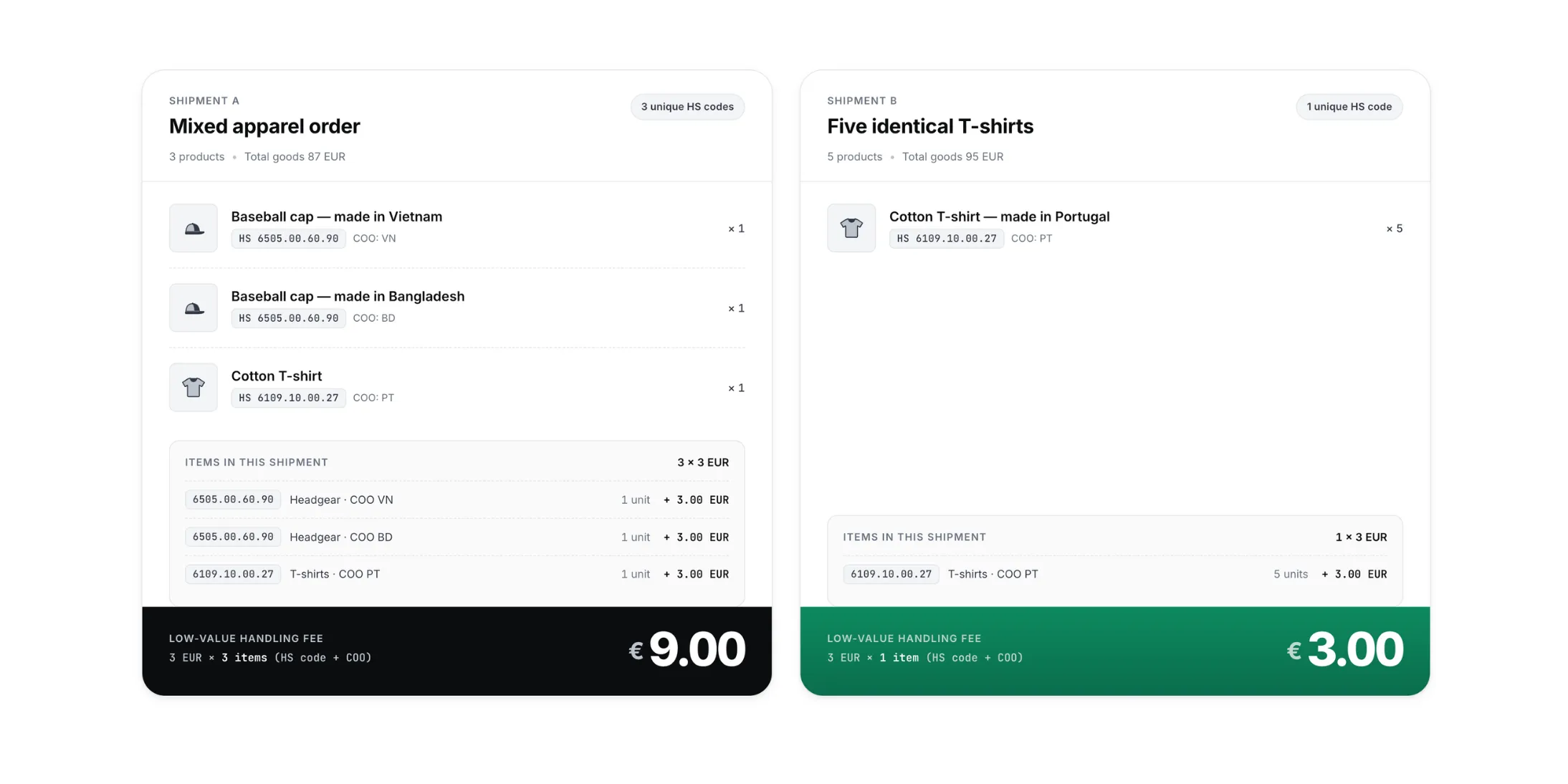
In its place, for IOSS‑registered postal consignments under €150, is a temporary flat duty of €3 per item, filed under the H7 simplified declaration. The Delegated Regulation defines an "item" as goods in a consignment sharing the same tariff classification, description, and (where origin is a required data element) origin.
A few details worth flagging up front:
- "Per item" is not "per parcel," and "item" isn't just HS code. Per the Delegated Regulation, goods group on a single line only when all three of these match: tariff classification, description, and (where origin is a required data element) origin. A parcel with three goods that differ on any of those criteria owes €9, not €3. Identical goods grouped on a single line still owe €3 total.
Click image to enlarge
- The flat rate applies to IOSS holders and postal consignments only. Non-IOSS commercial shipments under €150 still file the H7 simplified declaration, but owe duty calculated at the standard tariff rate, not the €3 flat rate.
- C2C shipments between private individuals remain exempt below the applicable threshold. However, platforms and marketplaces that host both private sellers and commercial sellers can't apply the exemption to their entire volume; it only applies transaction by transaction. A private individual selling secondhand goods is exempt. A small business using the same platform to sell at commercial volume is not, regardless of how the platform categorizes them.
Phase 2 (November 1, 2026): what kicks in by November
Identifiers
Beginning November 1, distance sale declarations must include up to three identifiers for every line: SKU, manufacturer product ID, and a standardized identifier (GTIN, EAN, or UPC where one exists). These are voluntary from July 1 and required from November 1.
This is a real operational change. Most origin postal operators don't collect product identifiers today, and most merchants don't flow them through their export data. The work to be ready for November starts now, on both sides of the shipment flow.
Union-wide handling fee
A separate Union‑wide handling fee (the €2‑per‑parcel figure that circulated earlier) is not in the latest released regulation. The amount won't be final until that act publishes. Anyone modeling landed cost should treat the €2 figure as a placeholder for now.
Member‑state fees aren't waiting, though. France's €2 fee on small parcels has been live since March 1. Romania introduced its own fee of approximately €5 per parcel in January. Italy delayed its fee from January but has it back on the books for July 1. This patchwork is operational reality today, ahead of any Union‑level rollout.
Phase 3 (around 2028): full tariff‑based assessment
The €3 flat rate is a bridge, not the destination. Once the EU Customs Data Hub is operational (the Commission's target is 2028, with a built‑in requirement to propose an extension if the system isn't ready), the simplified rate is replaced by full classification‑based duties tied to HS codes and country of origin.
The structural change nobody is leading with
Behind the €3 is a much more consequential shift: the regulation establishes a legal hierarchy of who owes the duty.
The declarant chain looks like this:
- The IOSS holder, typically the seller or marketplace.
- The IOSS holder's indirect representative.
- An importer representative.
- Any other person who is able to provide all of the information required and present the goods or have them presented to customs (for example, a third‑party declarant, destination carrier, or postal operator).
Posts have the option to step into #4, but most won't accept the liability and will instead return the shipment to the sender.
The IOSS holder is the primary customs debtor. The recipient is not. That is a fundamental departure from how postal customs has historically worked, where the consignee effectively functioned as the importer of record and duties were collected at delivery.
That model doesn't fit the new framework. The €3 is a customs debt owed by the declarant, not a delivery‑time fee that a post can collect from the consumer at the door. The "can't collect from the recipient" problem postal operators are flagging is real, and the regulation is explicit about it.
A few implications this surfaces
- IOSS does not cover the duty. IOSS handles VAT. The €3 customs duty is a separate obligation. A merchant with an IOSS number who assumes they're covered is wrong. The regulation explicitly ties the IOSS registration to the seller's customs debt, meaning IOSS now anchors both VAT and customs liability, not just VAT.
- Posts face a choice if no one upstream steps up. If a parcel arrives without an IOSS holder, indirect representative, or importer representative on the declaration, the destination postal operator can opt into the residual #4 slot, but doing so would make them the customs debtor. In practice, most posts are expected to return the shipment to the sender rather than absorb that liability. For high‑volume corridors without an EU‑established declarant in place, this turns into a structural compliance gap, not a billing inconvenience.
- Without a declarant, parcels don't move. Volume that arrives without a properly designated declarant won't clear. Parcels get rejected and returned. This isn't a billing inconvenience; it's a structural compliance gap.
- Returns can't unwind the declaration. Once duty is paid on a low‑value distance sale shipment, the simplified declaration can no longer be invalidated through the usual return process. Reverse logistics flows need to account for the fact that returned goods don't restore the duty.
Why the in‑house alternatives are harder than they look
For senders weighing how to comply, the realistic options narrow quickly. One path is to coordinate directly with each of the 27 member‑state customs authorities, picking up bilateral relationships, declarant arrangements, and country‑specific reporting along the way. Another is to stand up an EU entity to act as the company's own declarant, with all of the regulatory, tax, and operational considerations that come with operating an EU subsidiary that wouldn't otherwise be part of the business.
Both paths are valid, but they carry meaningful overhead, particularly for merchants and posts that don't otherwise need an EU presence. The third path, working through an established EU intermediary, is designed to avoid that overhead by absorbing the 27‑market complexity and the EU‑side compliance burden into a single relationship.
What this means in practice
For merchants
- IOSS is now the legal link between your VAT obligation and your customs debt, not just a VAT shortcut. However, duties are not paid via IOSS remittance.
- On postal shipments and shipments using IOSS, landed cost calculations need per‑HS‑code‑line math, not per‑parcel. (For commercial shipments and those not using IOSS, the standard duty applies.)
- Returns won't recover the €3 through the normal invalidation process; it's important to model this into your unit economics.
- Product identifier capture (SKU, manufacturer ID, GTIN / EAN / UPC) needs to be in your data pipeline by November 1.
For postal operators and carriers
- You need a designated declarant in place before July 1 (not after) for every EU member state.
- Member‑state fees in France and Romania are already live.
- Origin posts in particular need to know who is filing on their behalf inside EU customs territory, because they don't have a domestic declarant option.
For platforms and marketplaces
- The C2C exemption for private individuals remains, which matters for mixed‑flow platforms. Business sellers operating at commercial volume through a C2C interface don't receive this exemption.
- Your seller flows need to surface and validate IOSS numbers, and clarify which leg of the chain is filing.
How Zonos is supporting you
Zonos is building inbound EU duty and fee calculation, collection, and compliance the same way we already operate for U.S. inbound. That includes:
- Calculating the €3 per‑HS‑code‑line duty correctly across IOSS and non‑IOSS flows, including the standard duty path for non‑IOSS commercial shipments under €150.
- Working through the new EU customs regulations and coordinating with our postal partners to handle the compliance, customs filing, and liability obligations so merchants and postal operators don't have to.
- Capturing product identifiers (SKU, manufacturer ID, GTIN / EAN / UPC) ahead of the November 1 mandate.
- Tracking member‑state‑level fees as they evolve, so landed cost stays accurate as France, Romania, Italy, and others adjust.
- Adapting as the Union‑wide handling fee, if and when it lands, takes effect, and as the Customs Data Hub eventually replaces the flat rate with full tariff assessment.
The EU is eliminating its duty-free threshold. Here's what that actually changes.